July 4, 2026 came and went, and if you were shopping for a leased or PPA-financed solar system this spring, you probably heard the phrase “we can still safe-harbor your project” more than once. Installers used it as a closing argument. Sales teams used it as urgency. Almost none of them explained what it actually meant.
Here is the plain version: “safe-harbored” refers to a legal test — not a marketing promise — that determines whether the company that owns your leased or PPA-financed system can claim a federal tax credit worth up to 30% of the project’s cost. That credit, under Section 48E of the Internal Revenue Code, is available only to whoever owns the solar equipment. Under a lease or power purchase agreement (PPA), that is the solar company, not you. Whether the company can claim it — and therefore whether that value ever shows up in your monthly rate — depended on whether the company’s construction activity crossed a legal threshold called “beginning of construction” before July 4, 2026, or whether the completed system beats a hard December 31, 2027 placed-in-service deadline.
If you signed a contract this spring or you’re evaluating one now, understanding what actually happened around that deadline — including a court ruling that scrambled the rules three weeks before it hit — matters more than the deadline date itself.
Why July 4, 2026 Existed in the First Place
The One Big Beautiful Bill Act (OBBBA), signed into law exactly one year earlier on July 4, 2025, repealed Section 25D — the 30% Residential Clean Energy Credit that homeowners who bought their systems outright had claimed since 2006 — for any system placed in service after December 31, 2025. If you own your system via cash or loan and it went into service in 2026, there is no federal credit. That part of the law is settled and not in dispute.
Section 48E, the commercial investment tax credit that applies to businesses that own solar equipment, was not repealed. OBBBA instead set a construction-start deadline for it: projects that begin construction by July 4, 2026 get a four-year window to be placed in service and still qualify for the full credit. Projects that begin construction after that date must be placed in service by December 31, 2027 — a much tighter window, and one that is functionally unworkable for many residential jobs delayed by permitting or utility interconnection queues.
Because leases and PPAs are structured so the installer or a third-party finance company owns the equipment, Section 48E — not Section 25D — governs their economics. That is why “safe harbor” and “beginning of construction” became homeowner-facing sales language this spring, even though the legal test applies to the company, not to you.
What “Beginning Construction” Actually Requires
“Beginning construction” is not the day you sign a contract, and it is not the day a truck shows up with your panels. It is a specific legal test defined by the IRS, and in August 2025 the agency tightened it substantially.
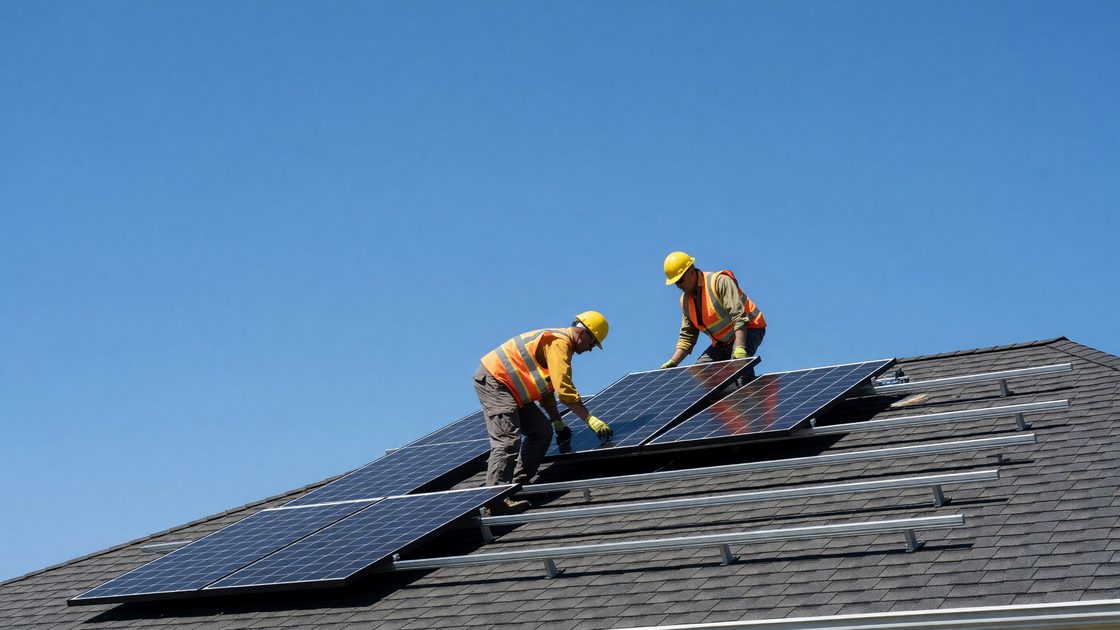
IRS Notice 2025-42, issued in response to OBBBA, eliminated the long-standing “5% safe harbor” — a rule that had let developers establish a construction-start date simply by spending 5% of a project’s expected cost, often on equipment procurement alone. In its place, Notice 2025-42 required most solar and wind projects to satisfy the Physical Work Test: actual on-site or off-site physical work of a significant nature, not preliminary activity. The notice was explicit that planning, permitting, engineering studies, and securing financing do not count, even if their cost is included in the project’s depreciable basis. Pouring a foundation, installing racking, or beginning module mounting does.
Notice 2025-42 carved out one exception relevant to almost every homeowner reading this: “low output” solar facilities with a maximum net output of 1.5 megawatts or less — which covers essentially every residential rooftop system — could still use either the Physical Work Test or the 5% safe harbor. A typical home solar array runs 5 to 15 kilowatts, thousands of times smaller than the 1.5-megawatt threshold. So for most individual residential installations, the harder test never actually applied. Where it mattered was for the companies that lease and finance those systems, which sometimes aggregate large batches of individual home installations into a single qualifying facility for tax purposes — a structure the Physical Work Test made considerably harder to satisfy on a tight timeline.
The Complication Nobody’s Sales Pitch Mentioned: A Court Vacated the Rule
Three weeks before the deadline, the ground shifted. On June 6, 2026, the U.S. District Court for the District of Columbia vacated Notice 2025-42 in its entirety, ruling in Oregon Environmental Council v. IRS that the agency had acted arbitrarily and capriciously under the Administrative Procedure Act when it eliminated the 5% safe harbor. The court’s order restored the 5% safe harbor as an available construction-start test for wind and solar facilities of any size — not just the sub-1.5-megawatt exception Notice 2025-42 had already preserved.
That sounds like unambiguous good news for developers racing the clock, and for three weeks it functioned that way in practice: companies that had been boxed into the stricter Physical Work Test suddenly had the option to establish a construction date by spending 5% of project costs instead. But the ruling came with real uncertainty attached. Tax and energy-project attorneys covering the decision noted that the federal government was expected to seek a stay and pursue an appeal, and that the appellate timeline would almost certainly run past July 4, 2026 without resolving the underlying question. A vacatur under appeal is not the same thing as settled law — a company that safe-harbored a project using the 5% method during that window took on litigation risk that the Physical Work Test does not carry.
What this means practically: when an installer told you this spring that your project was “safe-harbored,” ask which test they used and get it in writing. A company that documented actual physical work — racking delivered and installed, foundation work started, panels mounted — has a materially stronger position than one that relied solely on a cost-percentage threshold established during a three-week window of contested legal authority. As of this writing, no new IRS guidance had been issued in response to the ruling, and the government’s appeal path remained open.
The Deadline You Should Actually Be Tracking Now
If you’re evaluating a lease or PPA proposal today, the July 4 deadline has already resolved one way or the other for any given project — either the company’s construction activity crossed the threshold or it didn’t. The number that matters to you now is the one that follows from that outcome:
- If the installer’s project began construction on or before July 4, 2026 (documented via the Physical Work Test, or via the 5% safe harbor if the company is comfortable with the litigation exposure): the project gets a four-year continuity safe harbor. A project that began construction in 2026 before the deadline generally has until the end of 2030 to be placed in service and still claim the credit.
- If construction began after July 4, 2026: the project must be placed in service by December 31, 2027 — full stop, no four-year cushion. Given that residential installations typically run 60 to 120 days from permit to interconnection under normal conditions, and considerably longer where utility interconnection queues are backed up, any contract signed late in 2026 or in 2027 carries real risk of missing that date if anything in the process slips.
Ask your installer directly which bucket your project falls into, and ask what happens to your contract if the company’s underlying tax position is later challenged on appeal or the credit is disallowed. A well-structured lease or PPA contract prices the Section 48E credit into your rate at signing — it should not expose you to a rate increase if the company’s tax position changes after the fact. If a sales representative can’t answer that question clearly, that itself is useful information about how carefully the deal was structured.
Does This Affect Homeowners Who Buy Outright?
No. Section 25D, the credit for homeowners who purchase their systems with cash or a loan, was repealed for systems placed in service after December 31, 2025, and nothing about Notice 2025-42, its vacatur, or the July 4 construction deadline changes that. The safe-harbor fight is entirely about Section 48E, which only ever applied to the entity that owns the equipment — meaningful for lease and PPA structures, irrelevant to a cash or loan purchase where you own the system yourself. If you’re deciding between buying and leasing in 2026, the lease-versus-PPA economics comparison covers that decision separately from the construction-deadline question addressed here.
What to Verify Before Signing Anything Now
- Get the construction-start method in writing. Ask whether the company relied on the Physical Work Test, the 5% safe harbor, or both, and request documentation (not just a verbal assurance).
- Ask what happens if the company’s tax position is challenged. A properly structured contract insulates your rate from the company’s tax risk; an improperly structured one may not.
- Confirm your specific project’s placed-in-service deadline. 2030 (four-year continuity safe harbor) and 2027 (post-deadline placed-in-service requirement) are very different planning horizons for the installer, and a company juggling a large 2027 deadline queue may face capacity and scheduling pressure that a 2030-deadline project does not.
- Watch for new IRS guidance. The June 6, 2026 vacatur remanded the matter back to the IRS, and the agency retains the ability to issue revised guidance. Any homeowner mid-contract should ask their installer to flag material regulatory developments, not assume the picture is frozen.
Frequently Asked Questions
What does it mean when an installer says my solar project is “safe-harbored”?
It means the company that will own your leased or PPA-financed system has taken steps intended to establish, for tax purposes, that construction began before the July 4, 2026 deadline under Section 48E. This determines whether the company can claim the 30% federal tax credit and, in turn, whether that value is reflected in your lease payment or PPA rate. It is a claim about the company’s tax position, not a guarantee about your contract terms.
Does the safe-harbor deadline affect homeowners who are buying their solar system outright?
No. The July 4, 2026 construction-start deadline applies to Section 48E, the commercial credit claimed by whoever owns the equipment. Homeowners who purchase their system with cash or a loan own the equipment themselves and are governed by Section 25D, which was repealed for systems placed in service after December 31, 2025 — unrelated to the Section 48E construction-start rules.
What happens if my installer’s construction-start documentation turns out to be insufficient?
If the IRS later determines the company did not properly establish beginning of construction, the company — not you — bears the direct tax consequence of losing the credit. Whether that affects your contract depends on how the lease or PPA agreement is written. Ask your installer in writing whether your rate is contractually protected from changes tied to the company’s tax position before signing.
Why did a federal court ruling on Notice 2025-42 matter for the July 4 deadline?
Notice 2025-42 had eliminated the simpler 5% cost-based safe harbor for most solar projects above 1.5 megawatts, requiring the stricter Physical Work Test instead. When a federal court vacated that notice on June 6, 2026, it reopened the 5% safe harbor as an option for companies racing the July 4 deadline — but the ruling was expected to face a government appeal, which added legal uncertainty to any project that relied on the restored safe harbor rather than documented physical construction work.
Further Reading from Authoritative Sources
- IRS Notice 2025-42 — Beginning of Construction for Sections 45Y and 48E — the IRS guidance document (subject to the June 2026 vacatur) that defined the Physical Work Test and the low-output solar exception.
- DOE Homeowner Solar Resources — the Department of Energy’s guide to financing and evaluating residential solar, including third-party ownership structures.
- DSIRE Incentive Database — maintained at North Carolina State University; tracks state and utility-level incentives that apply regardless of federal credit status.