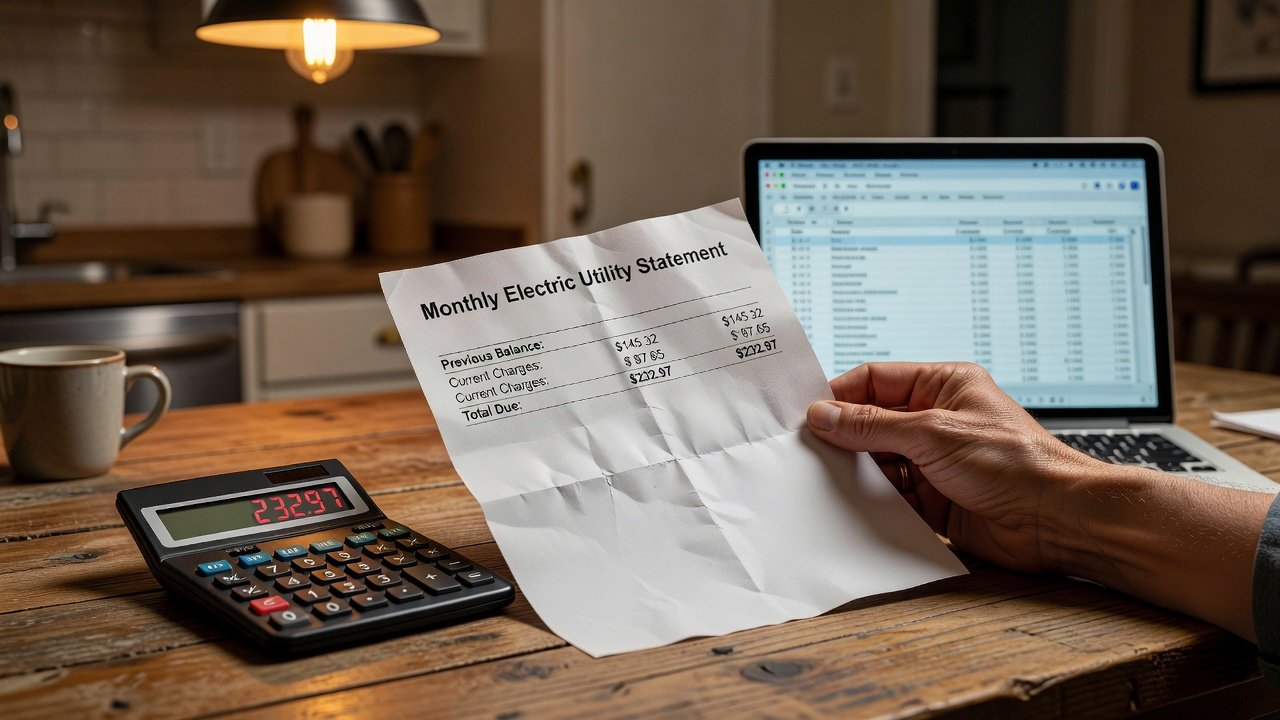
Net metering gets most of the attention when homeowners worry about utilities changing the rules on solar. But a separate rate-design lever has been moving in parallel, and it works differently: instead of changing what a solar export is worth, it raises the flat amount every customer pays every month just to be connected to the grid — a charge that solar production, no matter how efficient the system, cannot offset. That distinction is why a rate case built around raising the fixed charge can quietly erode payback math even for a homeowner whose net-metering terms haven’t changed at all.
The Mechanism, in Plain Terms
Most residential electric bills have historically bundled two things into a single volumetric rate: the cost of the energy itself, and a share of the fixed costs of running the grid — poles, wires, transformers, metering, billing — that don’t scale with how much electricity a household uses. Utilities have long recovered some of those fixed costs through a small monthly “customer charge,” but the bulk got folded into the per-kWh rate. A rate case that raises the fixed charge shifts more of that fixed-cost recovery out of the volumetric rate and into a flat line item.
For a full-usage household, the net effect on the total bill can be close to neutral if the volumetric rate drops to compensate. For a household that has shrunk its grid purchases — because solar is covering most of its usage — it isn’t neutral at all. A bigger fixed charge is money paid regardless of how little grid electricity gets bought, and unlike a per-kWh charge, solar production has no mechanism to reduce it. That’s the specific reason utilities proposing these charges, and the analysts who model them, describe fixed-charge increases as a more durable way to recover grid costs from solar customers than adjusting the export rate, which only affects the portion of production a system sends back to the grid.
A Live Example: California’s Income-Graduated Fixed Charge
The most fully documented case of this mechanism running at scale is California’s. Assembly Bill 205 (2022) directed the California Public Utilities Commission to authorize the state’s investor-owned utilities to restructure residential bills around an income-graduated fixed charge. The CPUC adopted the framework in Decision 24-05-028, issued May 9, 2024, in Rulemaking R.22-07-005. The adopted structure sets three tiers for the three large electric IOUs (PG&E, SCE, and SDG&E): roughly $6 a month for CARE-enrolled low-income customers, roughly $12 a month for FERA/affordable-housing-eligible customers, and $24.15 a month for everyone else.
Southern California Edison began billing its $24.15 fixed charge in November 2025. PG&E followed with its own version — branded the Base Services Charge — starting March 1, 2026, replacing the prior Minimum Electric Charge and running roughly $10 higher than what it replaced. PG&E’s own customer-facing billing materials state the point directly: the Base Services Charge is not eligible to be offset by monthly generation credits from a customer’s solar system, unlike the charge it replaced. That’s the mechanism described above, made concrete and dated: a specific dollar figure, tied to a specific CPUC decision, that solar production cannot reduce.
For a low-usage or highly solar-offset household, the arithmetic is straightforward. A homeowner whose system covers most of their draw might see their volumetric bill shrink toward zero in a given month, but the $24.15 charge doesn’t shrink with it. Spread across a year, that’s roughly $290 that a system with strong production still can’t touch — a fixed subtraction from payback calculations that predates the charge.
It’s Not Only a California Story
California’s fixed-charge fight draws outsized coverage because of the size of its solar market, but it isn’t isolated. The N.C. Clean Energy Technology Center’s quarterly “50 States of Solar” report tracks residential fixed-charge and minimum-bill proposals as one of its standing policy categories alongside net metering and community solar, and its Q2 2026 edition counted 45 states that had taken some form of distributed-solar policy action that quarter, with fixed-charge and minimum-bill changes among the most active categories tracked. The specifics vary enormously by state and even by individual utility rate case — some proposals are modest, others contested and scaled back by regulators — which is exactly why a homeowner evaluating a quote should ask what their own utility has proposed or adopted, rather than assuming the net-metering terms they’ve read about are the whole picture.
What This Means for a 2026 Solar Shopper
A few things are worth checking before signing, specifically because this charge type is easy to miss in a sales proposal that emphasizes the export rate or the payback period:
- Ask what portion of the current bill is fixed versus volumetric, and whether the utility has an open or recently decided rate case proposing to change that split. A state PUC’s docket search is public record for any open case.
- Recalculate payback with the fixed charge held constant. A proposal that assumes today’s fixed charge for the full loan or ownership term may be understating future bills if a rate case is pending.
- Distinguish this from net-metering export-rate cuts. They’re separate levers, they show up as separate line items, and a jurisdiction can move on one without touching the other — California’s Net Billing Tariff and its income-graduated fixed charge are legally distinct proceedings that happen to compound for the same solar household.
- Ask the installer whether their savings estimate models the fixed charge as static. Many do, because it’s the simpler assumption — but it’s the one most likely to be wrong over a 20-to-25-year system life if a state’s rate-design trend continues.
The direction of travel across ratemaking dockets nationally favors more fixed-cost recovery through flat charges, not less, because it gives utilities more revenue certainty as more customers install generation of their own. A homeowner doesn’t need to track every state’s docket to plan around this — but understanding that the mechanism exists, and asking one direct question about it before signing, is enough to keep it from becoming a surprise line item two years into ownership.