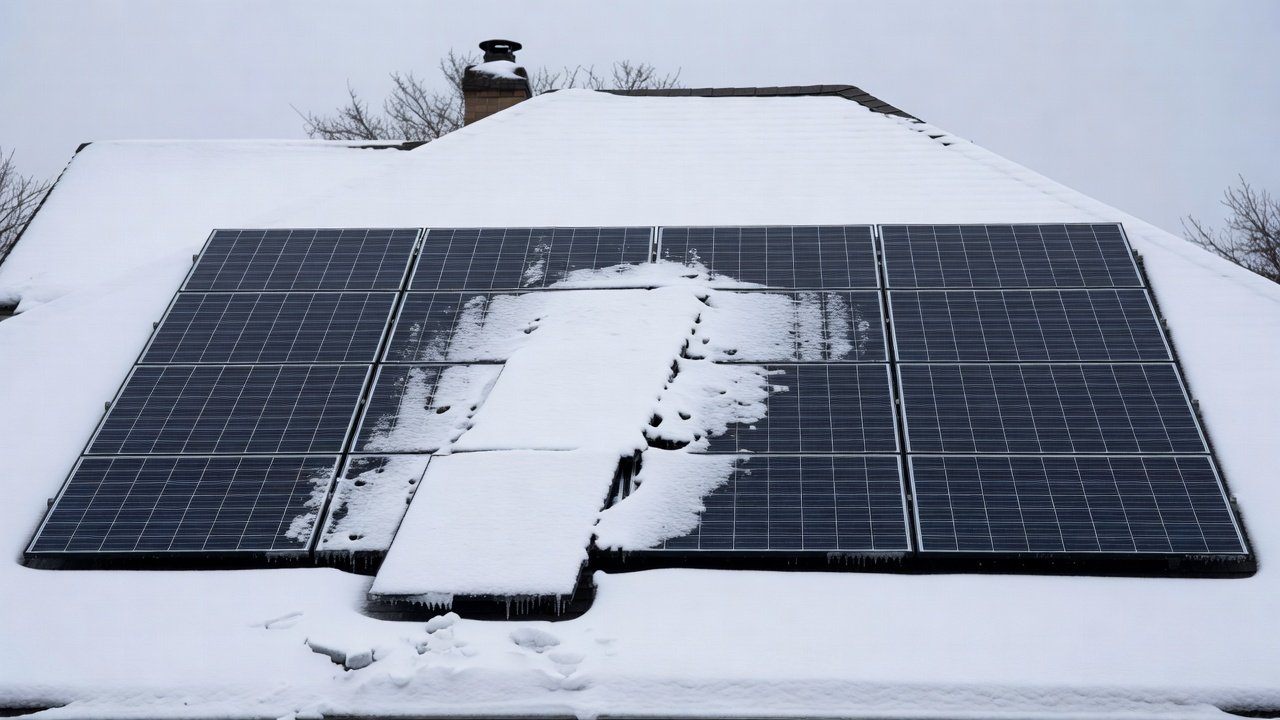
Homeowners in snow country ask two questions about rooftop solar, and they usually ask them in the wrong order. The first is how much production winter costs them. The second is whether the roof can carry the extra load. The second question is the one that can fail a permit or damage a structure, and it is the one with the firmest answers.
What Snow Actually Costs You Annually
The number that matters is annual, not seasonal. Sandia National Laboratories, which runs field research on snow effects at sites including Michigan Technological University in Houghton, the University of Michigan, and two Alaska locations, summarizes the literature this way: published estimates of energy losses range from 1% to 12% annually, with monthly losses as high as 100%, depending on location and weather.
That spread is the honest answer, and the gap between the two ends of it is the whole design conversation. A December that returns nothing is compatible with an annual loss of 4%, because December was never going to be a big production month in Minnesota anyway. Winter months in northern latitudes carry short days and low sun angles regardless of snow. Losing most of a month that was only ever worth 3% of annual output is a rounding error; losing a share of March, when the sun is back and the snow is still falling, is not.
The modeling work behind those numbers traces largely to Bill Marion’s snow-coverage model, published as Measured and Modeled Photovoltaic System Energy Losses from Snow for Colorado and Wisconsin Locations (Solar Energy, vol. 97, pp. 112–121, 2013) and since adapted into NREL’s System Advisor Model. It estimates the fraction of each row’s slant height covered by snow at each time step, treating sliding — not melting, and not wind — as the dominant clearing mechanism.
That modeling assumption has a practical consequence worth knowing: because the model does not credit melting or wind removal, and real arrays get help from both, modeled snow losses tend to run conservative. A proposal that shows you a snow-loss line derived from SAM is more likely pessimistic than optimistic.
The Tilt Question, Answered Honestly
The standard advice is that steeper panels shed snow better, with recommendations clustering around 35° to 50° for heavy-snow regions, or latitude plus 15°.
Two things complicate that advice for an actual homeowner.
First, the relationship is not as clean as the rule of thumb implies. NREL’s national modeling comparing fixed-tilt-at-latitude against a constant 20° tilt found a non-monotonic decrease in annual snow losses as tilt increased — meaning more tilt did not reliably produce proportionally less loss in every case. Snow behavior involves adhesion, module surface temperature, freeze-thaw cycling, and whether shed snow piles up at the array’s lower edge and bridges back up into the modules. Angle alone does not govern it.
Second, and more decisively: on a flush-mounted rooftop retrofit, tilt is not a variable you control. The array follows the roof pitch. A 5:12 roof gives you roughly 22.6°, and no racking decision changes that without tilt-up hardware that raises wind loading, cost, and visual objection — and often runs into setback and fire-access constraints anyway.
So the tilt lever is real for ground mounts, pole mounts, and new construction where roof pitch is still being chosen. For the typical retrofit, it is not the decision. The decisions that remain are:
- Where the array sits on the roof. Leaving clearance below the lowest row so shed snow has somewhere to go matters more than a few degrees of pitch.
- Whether modules are framed or frameless. Sandia’s work explicitly compares the two, because a frame’s lower lip forms a lip that retains a band of snow and ice after the rest of the sheet slides.
- Row spacing on multi-row layouts, which governs both inter-row shading in low winter sun and where drifts form.
One more piece of physics that surprises people: modules continue producing under thin snow. NREL’s work found measurable generation beneath snow cover of several centimeters. Light transmits; a dusting is not an outage. This is also why partial clearing can restore disproportionate output — a strip of exposed cells warms, and the warming accelerates the slide.
Snow Load Is the Part That Can Actually Fail
The structural side changed recently enough that it catches people mid-project.
ASCE 7 is the loading standard that sets minimum wind, snow, seismic, and gravity loads for the mounting system and the structure beneath it. Which edition applies depends on the building code your jurisdiction has adopted: the 2021 IBC references ASCE 7-16, while the 2024 IBC references ASCE 7-22. As jurisdictions adopt the 2024 IBC, projects move onto the newer standard.
That transition is not cosmetic. ASCE 7-22 rebuilt the ground snow load maps on decades of additional data, producing more granular site-specific values — and the new loads run roughly 12% higher on average, with much larger increases in some northern and mountain regions. A design that cleared under ASCE 7-16 does not automatically clear under 7-22.
Three specifics to raise with an installer working in snow country:
Ground snow load (pg) determination. The starting input comes from the ASCE 7 maps or from the local authority having jurisdiction, which in many mountain counties publishes its own values that override the map. Ask which source was used.
Drift loading between and around the array. This is the failure mode people miss. A uniform snow load across a bare roof is a simple calculation. Modules interrupt the natural movement of snow across that roof, so snow accumulates unevenly — building drifts at panel edges and in the channels between rows that exceed the uniform design load. ASCE 7 requires those drift conditions to be modeled explicitly rather than absorbed into an average.
Dead load from the array itself. A rooftop PV system adds roughly 3 to 5 psf over the collector area for standard rail-mounted residential work, and substantially more for ballasted mounting — which is why ballasted systems are largely a flat-roof commercial technique, not a residential snow-country one. That dead load stacks with the drift load, not with the average.
ASCE 7-22 also divides each roof into field, edge, and corner zones, with edges and corners seeing higher pressures and therefore requiring tighter attachment spacing. Snow drift and wind zone requirements interact at exactly those perimeter locations.
What to Ask Before Signing
For a snow-region quote, four questions separate a designed system from a templated one:
- Which ASCE 7 edition did the structural calculation use, and does it match the code edition my jurisdiction has adopted?
- What ground snow load value was used, and did it come from the map or from the local authority?
- Were drift loads at array edges and between rows modeled separately from the uniform load?
- What annual snow-loss percentage is in the production estimate, and what model produced it?
A designer who answers all four without hesitating has done the work. A production estimate with no snow-loss line at all is the clearest warning sign on the page — not because the number will be large, but because its absence means nobody ran the calculation.
Winter in a snow climate is a manageable, quantifiable haircut on annual production. The structure carrying the array through February is the part worth being conservative about.