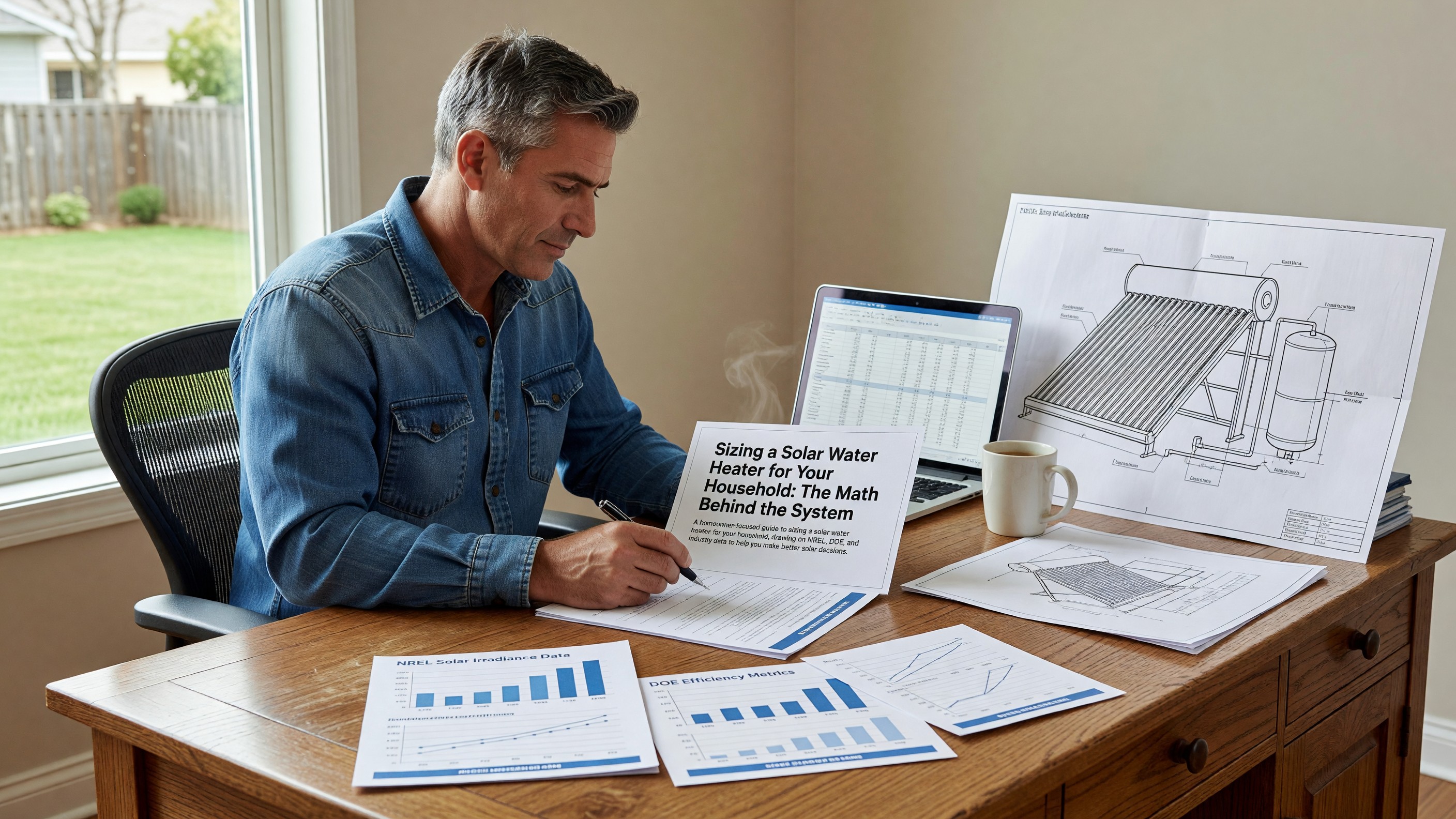
Sizing a Solar Water Heater for Your Household: The Math Behind the System
Sizing a Solar Water Heater for Your Household is one of those topics where the difference between a good decision and a costly one comes down to a handful of details most homeowners never see in a sales presentation. This guide draws on data from NREL, the Department of Energy, and field-tested industry practice to give you a working framework you can apply before you sign anything. The goal is not to make you an installer — it is to make you a buyer who knows which questions matter and which answers should make you walk away.
Why Sizing a Solar Water Heater for Your Household Matters More Than Most Homeowners Realize
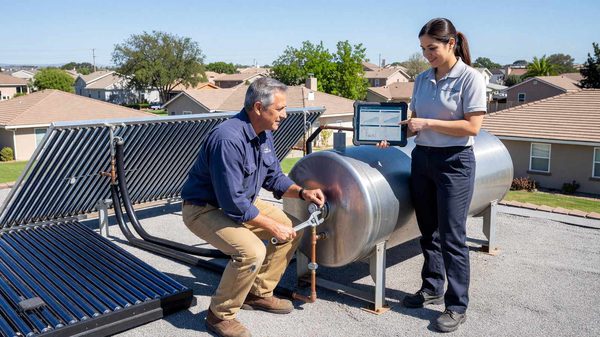
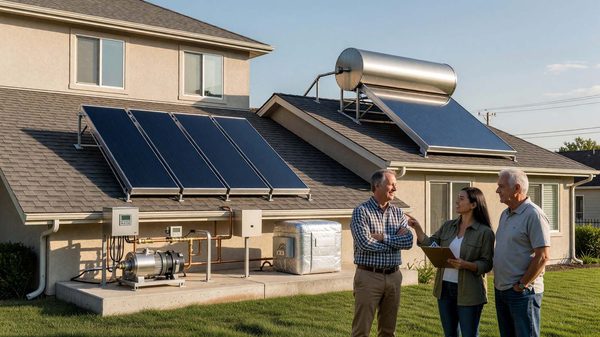
When the National Renewable Energy Laboratory reviews residential solar performance data, the gap between top-performing and bottom-performing systems on otherwise similar homes is consistently larger than the published equipment differences would predict. A meaningful share of that gap traces back to choices made in the area covered by this guide. Decisions here compound across 25 years of system life: a small percentage difference in annual output, financing cost, or operating expense becomes thousands of dollars in lifetime value. Treating sizing a solar water heater for your household as a routine line item rather than a strategic decision is one of the most common — and most expensive — mistakes in residential solar. On the solar thermal side, modern SRCC-certified systems can offset 50 to 80 percent of a household’s water heating energy use according to DOE estimates. Performance varies more by climate, system type (drainback, glycol, ICS, thermosiphon), and storage tank sizing than by collector brand. Freeze protection, scale management, and pump controller reliability are the maintenance issues that determine whether a system meets its 20+ year design life. For a complementary read, see our guide to active vs passive solar water heaters.
The Core Concepts You Need to Understand
Three concepts do most of the work in evaluating sizing a solar water heater for your household. First, the underlying physics or financial mechanics — what is actually happening when the system operates, the money moves, or the policy applies. Second, the variables under your control versus the variables fixed by site, utility, or regulator. Third, the trade-offs that pricing and marketing tend to hide. DOE’s residential solar literature is unusually clear on the first concept, and the IRS, state energy offices, and DSIRE database are the authoritative sources for the policy mechanics where they apply. The variables under your control are where buyer attention is worth the most, because that is where contractor proposals diverge.
What the Data Actually Shows
NREL’s annual benchmark reports, EIA’s residential energy consumption surveys, and Lawrence Berkeley National Lab’s tracking-the-sun database all support the same general pattern: averages hide enormous variation, and the variation is largely explained by a small number of factors. For example, a typical U.S. household consumes about 10,500 kWh per year per EIA, but the 10th and 90th percentile of households differ by more than a factor of three. Solar production likewise varies more than 35 percent between equivalent systems in different microclimates and orientations. The practical takeaway: do not rely on national averages or rules of thumb for your specific decision. Run the numbers for your home, your utility tariff, and your usage pattern.
Common Mistakes Homeowners Make
The pattern repeats across thousands of installations documented in the Tracking the Sun dataset. Homeowners under-research the specific topic, accept the first contractor’s proposal at face value, and discover after installation that a different decision would have produced materially better economics or performance. Three mistakes dominate. First, optimizing on upfront cost rather than 25-year cost of ownership. Second, failing to read the fine print on warranties, performance guarantees, and incentive eligibility. Third, ignoring how utility tariff structures change the value of every kilowatt-hour the system produces or stores.
Numbers That Should Anchor Your Decision
A few benchmark numbers will keep you grounded as you read proposals. According to NREL’s 2024 U.S. Solar Photovoltaic System and Energy Storage Cost Benchmark, the median residential PV installed cost is approximately $2.85 per watt before incentives, with a typical range of $2.30 to $3.50 per watt. Standalone residential battery storage adds roughly $1,200 to $1,500 per usable kWh installed. The federal Residential Clean Energy Credit covers 30 percent of qualifying expenditures including labor, equipment, and sales tax. A typical 7 kW residential system in a moderate-irradiance climate produces 8,500 to 10,500 kWh per year, with first-year specific yield of 1,200 to 1,500 kWh per installed kW depending on tilt, orientation, and shading. Payback periods in 2024 run 7 to 12 years for cash purchases in markets with retail net metering and longer in markets without it. If a contractor quote departs materially from these benchmarks — much higher cost per watt, much higher production claims, or a payback period that seems too short — ask for the underlying assumptions in writing.
Regulatory and Utility Context You Cannot Ignore
Solar economics depend heavily on policies set by federal agencies, state legislatures, and individual utilities. The IRS administers the federal tax credit; eligibility is straightforward but the timing rules (placed in service in the tax year claimed) catch some homeowners. State-level net metering, successor tariffs, demand charges, and time-of-use rates can change the payback math by years. California’s NEM 3.0 transition in 2023, for instance, cut export compensation by roughly 75 percent for new systems and reshaped optimal system design toward storage. Similar transitions have rolled through Arizona, Hawaii, Nevada, and are under discussion in other states. Before you sign, confirm which net metering or successor tariff applies to your project, and read the tariff document — not the contractor’s one-page summary. Your utility’s website is the authoritative source.
How to Evaluate Proposals
When you receive contractor proposals, line them up side by side and compare the same line items across all of them. Specifically, look for production estimates that show monthly breakdowns, the modeling assumptions (degradation rate, system losses, weather data source), and any disclaimers about shading or future obstructions. Ask for the design layout PDF, not just the marketing summary. Confirm the equipment model numbers, not just brands. Request copies of any warranties before signing, and verify the manufacturer is financially capable of honoring a 25-year commitment — a panel warranty from a bankrupt company is worthless.
Putting It All Together
The homeowners who get the best outcomes on sizing a solar water heater for your household share a few habits. They invest a few hours of research before contacting contractors. They obtain at least three quotes and compare them on identical assumptions. They read warranty documents word by word. They confirm incentive eligibility with the actual administering agency, not the contractor’s sales sheet. None of this requires technical expertise. It requires the discipline to treat a 25-year purchase with the same rigor you’d apply to a mortgage or a vehicle, and to push back when proposals are vague or assumptions are hidden. You may also find our overview of Solar site assessment guide useful as you plan next steps.
Frequently Asked Questions
How long does sizing a solar water heater for your household typically take to evaluate properly?
Plan on a few hours of homeowner research and two to four weeks of contractor proposals, site visits, and revisions. Compressing this timeline is the single most reliable way to end up with a sub-optimal system.
What’s the most common mistake homeowners make here?
Optimizing for the lowest upfront price rather than the lowest 25-year cost of ownership. The cheapest proposal almost never produces the lowest lifetime cost once warranty risk, production differences, and financing terms are normalized.
Should I trust contractor production estimates?
Treat them as starting points. Ask which modeling software was used (PVsyst, Aurora, HelioScope) and what assumptions were made for shading, degradation, soiling, and system losses. Reasonable assumptions are 0.5 percent annual degradation, 2 to 3 percent soiling, and 14 percent total system losses.
Where can I find authoritative information that isn’t a sales pitch?
NREL (nrel.gov), the DOE’s Solar Energy Technologies Office, your state energy office, DSIRE for incentives, and the EnergySage and SEIA buyer’s guides. Cross-check any specific claim against at least one of these sources before relying on it.
Further Reading from Authoritative Sources
- DOE Energy Saver Solar Water Heater Sizing Guide — energy.gov is the primary federal authority on solar water heater sizing methodology directly cited in the article.
- NREL Solar Thermal Research — Collector Performance — NREL is the authoritative federal laboratory for solar thermal collector performance research that underpins sizing calculations in the article.