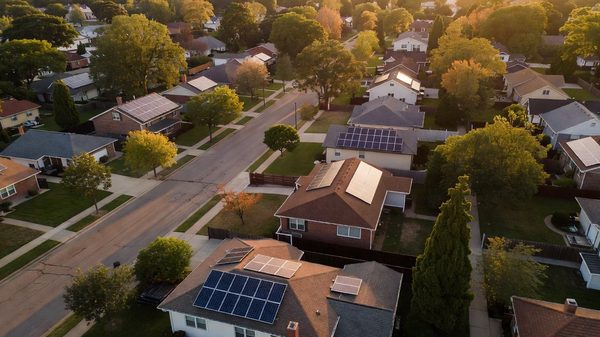
For years, “install before December 31” was the standard year-end solar pitch, and it was backed by a federal tax credit worth 30% of the system cost. For a homeowner who buys a system in 2026, that pitch no longer has a federal edge: the Section 25D Residential Clean Energy Credit does not apply to expenditures made after December 31, 2025. So if a salesperson is pressing you with a December 31 countdown this fall, the useful response is to ask which deadline they mean. Some real ones still exist, but they are narrower, they vary by state and utility, and several do not fall on December 31 at all.
What December 31, 2026 Does Not Do
The IRS has been explicit about how the repeal works. Under its published FAQ on the 2025 legislation, a 25D credit cannot be claimed for property installed after December 31, 2025, even if the homeowner paid for it earlier, because the expenditure is treated as made when the original installation is completed. That rule is why signing a contract or paying a deposit in late 2025 did not save a project that finished in 2026.
The practical effect for this fall: there is no federal credit waiting on the other side of a December 2026 install date, and none that disappears on it for a system you own. If your quote is built on a cash or loan purchase, a rushed December install gains you nothing federally. Our guide to life after the 25D repeal covers who can still claim carryforwards from earlier installs.
The Lease and PPA Window Runs on Its Own Clock
Leases and power purchase agreements are different because the solar company, not the homeowner, owns the equipment and claims the business credit under Section 48E. That credit survived the 2025 legislation with new conditions. As widely summarized by industry sources, third-party-owned projects qualify if construction began by July 4, 2026, or if the system is placed in service by December 31, 2027. Projects that started construction before the July 4 cutoff generally get a longer runway to be placed in service.
For a homeowner reading a lease or PPA quote in October 2026, this changes what to ask:
- Which bucket is my project in? A project that started construction before July 4 sits under a different deadline than one that started after.
- Is the placed-in-service date realistic? For a project in the second bucket, the end of 2027 is the outer limit, and interconnection queues can eat months. Our piece on rooftop solar interconnection delays explains where the slippage happens.
- Is the credit actually priced into my rate? The 48E credit belongs to the company. Whether it lowers your monthly payment or per-kWh rate is a pricing decision, so compare the lease or PPA offer against a loan quote line by line.
Our explainer on the July 4 safe-harbor deadline walks through what “beginning of construction” means and what to request in writing.
State Credits: Check the Rules Before the Calendar Flips
With the federal layer gone, a state income tax credit can be the largest remaining incentive for an owner, and these credits are not uniform.
New York’s Solar Energy System Equipment Credit equals 25% of qualified expenditures, capped at $5,000, per the state tax department. Notably, it is open not only to buyers but to homeowners who sign a written lease or a written agreement of at least ten years to purchase the power from a system they do not own. It is non-refundable, with unused amounts carried over for up to five years. Massachusetts offers a credit of 15% of net expenditures up to $1,000 per taxpayer, according to the state’s tax expenditure budget.
Two cautions apply before you build a December plan around a state credit:
- Programs can run out. South Carolina’s 25% credit, capped at $3,500 per facility, reached its $100 million aggregate cap in 2024 and, according to the state revenue department’s published guidance, is no longer accepting new claims. A credit that exists in last year’s brochure may not exist now.
- Tax-year timing is state-specific. A credit is claimed on a return for a particular tax year, and the state’s form instructions decide which year a project counts toward. Read them, or ask a tax preparer, before assuming that finishing in December rather than January changes anything.
The state’s revenue department, or DSIRE’s database of state incentives, is the place to confirm current terms. An installer’s summary is a starting point, not a source.
Utility Lock-Ins That Really Do End at Year-End
The deadline most likely to be a genuine December 31 cutoff is not a tax rule. It is a utility tariff.
In North Carolina, Duke Energy’s Residential Solar Choice Bridge Rate is open to customers who apply for net metering until December 31, 2026, subject to annual capacity caps. According to Duke’s own tariff sheet, the rider closes to new participants on and after January 1, 2027, and customers who applied before that date can stay on it for up to 15 calendar years from the date of their interconnection application. The point for a North Carolina buyer is that the application date, not the install date, can be what matters, so the interconnection paperwork has to be filed and accepted in time.
California works differently. Under the state’s Net Billing Tariff, installers and tariff summaries describe export rates as locked for nine years at the values tied to the year a system goes into service, so the timing of permission to operate can affect the export credit for a decade. Treat that as a question for your installer and utility rather than a settled figure, because the vintage-year mechanics have changed more than once.
Maryland is a reminder that a pending change can create a window of its own. A law signed in May 2026 requires regulators to adopt a successor net metering program with a lower compensation rate, effective by the earlier of July 1, 2027 or when the current tariff reaches its 3,000 MW cap, and it prioritizes applications already in the queue, according to the NC Clean Energy Technology Center’s Q2 2026 report. Whether to move quickly in a state like that depends on your own numbers, not a sales calendar.
A Year-End Checklist for Quotes
- Ask which specific deadline the installer is citing, and get the statute, tariff, or program name in writing.
- For a purchase, check your state’s credit page for current funding and the tax year it applies to.
- For a lease or PPA, ask about the construction-start status and the rate escalator, and compare against a loan quote.
- Ask your utility, not the installer, whether a tariff or net metering program is closing, and what date the application must be filed by.
- Treat any claim of a “federal deadline” on a homeowner-owned system in 2026 as a red flag worth questioning.
A system that makes sense on January 15 with a clean state credit and a stable tariff will still make sense then. The year-end decisions worth making are the ones where a documented rule, a named program, or a tariff close date ends on a specific day, and you can find that date on a government or utility page rather than a sales sheet.