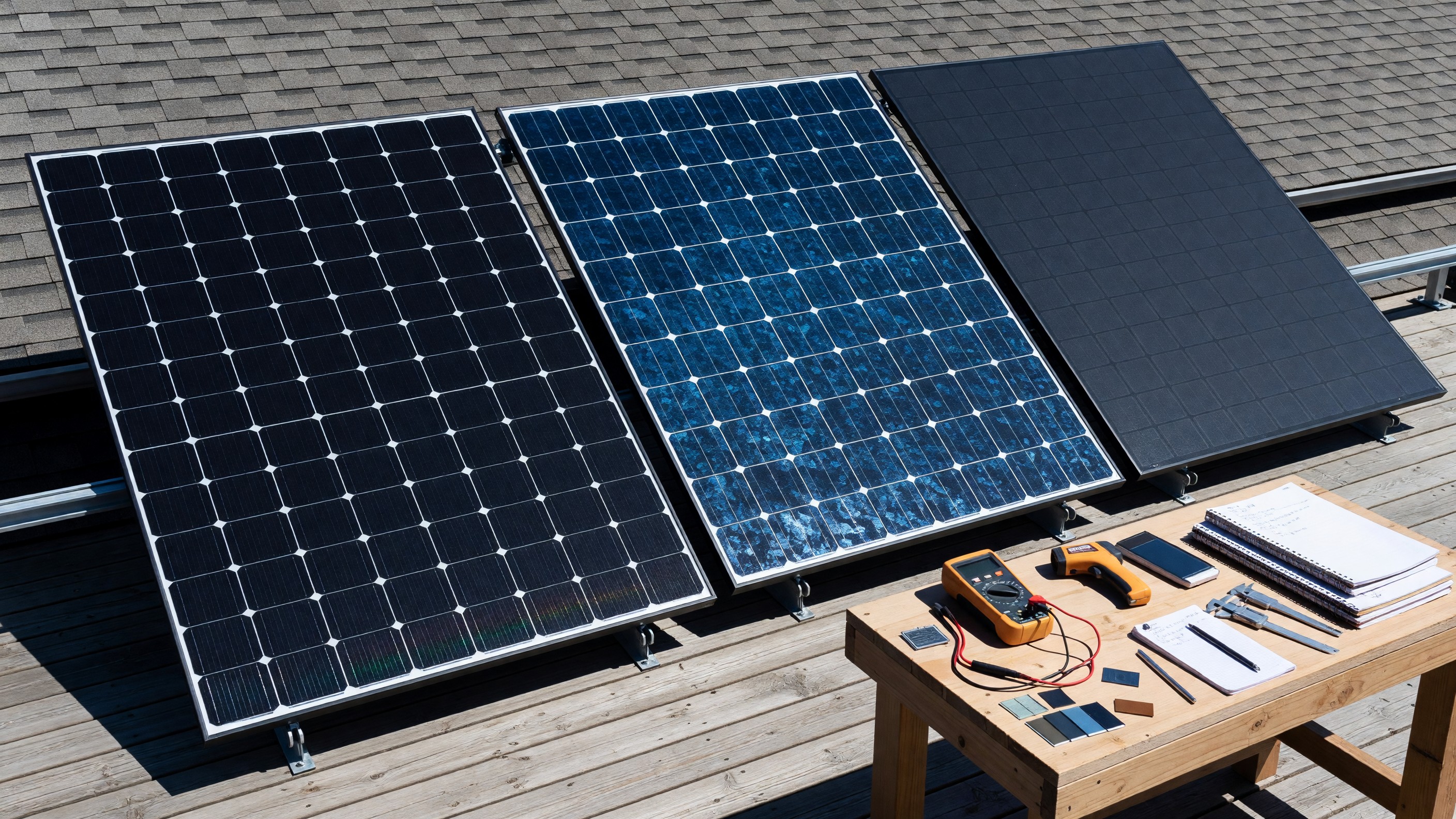
Three solar panel technologies dominate the residential market: monocrystalline silicon, polycrystalline silicon, and thin-film. They are not equally distributed — monocrystalline has decisively won the rooftop segment in 2026 — but the reasons matter, and the edge cases where the other two make sense are worth understanding before you accept whatever your installer puts on a quote.
How the Three Technologies Differ
Monocrystalline panels are built from silicon ingots grown as a single continuous crystal (the Czochralski process), then sliced into wafers. The uniform crystal lattice gives electrons a clean path, which translates into higher efficiency. Cells are visually identifiable by their dark, near-uniform black color and rounded corners (a remnant of the cylindrical ingot they were cut from).
Polycrystalline panels (also called multicrystalline) are made from silicon that’s been melted and cast into a block, producing many small crystals rather than one continuous lattice. The cells appear blue with a visible grain pattern. Manufacturing is cheaper and uses less energy, but the grain boundaries scatter electrons and lower the conversion efficiency.
Thin-film panels deposit a photovoltaic material — typically cadmium telluride (CdTe), copper indium gallium selenide (CIGS), or amorphous silicon (a-Si) — onto a substrate in a layer only a few micrometers thick. They use 1% of the active material of a crystalline panel, can be made flexible, and perform relatively well in heat and diffuse light. But they are far less efficient per square foot.
Efficiency: The NREL Numbers
The National Renewable Energy Laboratory tracks lab and commercial cell efficiencies in its long-running Best Research-Cell Efficiency Chart. For commercial residential modules in 2026:
- Monocrystalline (PERC, TOPCon, HJT): 20% to 23% module efficiency for mainstream products, with premium HJT (heterojunction) and TOPCon (tunnel oxide passivated contact) panels reaching 22.5%+. A few flagship residential modules now exceed 23%.
- Polycrystalline: 15% to 17% module efficiency. The technology has improved marginally but the efficiency gap to mono has widened, not narrowed, over the last five years.
- Thin-film (CdTe, CIGS): 11% to 15% module efficiency for residential-sized panels. First Solar’s utility-scale CdTe modules now exceed 19% in lab measurements, but those don’t translate directly to the residential form factor.
What this means in practice: to produce the same energy, a polycrystalline array needs roughly 20–30% more roof area than a modern monocrystalline array, and a thin-film array needs 40–80% more. For most U.S. roofs, that’s the entire argument.
Temperature Coefficient
Solar panels lose efficiency as they heat up. The temperature coefficient (expressed as %/°C) tells you how much. Every panel is rated at 25°C cell temperature, but operating cell temperatures of 50–65°C are routine on a hot roof.
- Monocrystalline PERC: −0.34% to −0.38% per °C
- TOPCon and HJT monocrystalline: −0.26% to −0.30% per °C (a meaningful advantage in hot climates)
- Polycrystalline: −0.40% to −0.45% per °C
- Thin-film (CdTe): −0.20% to −0.28% per °C — thin-film’s one area of clear technical advantage
A 30°C rise above standard test conditions costs a polycrystalline array roughly 12–13% of its output. The same rise costs a thin-film array about 6–8%. In Phoenix or Las Vegas, the thin-film temperature coefficient narrows the lifetime energy gap a bit — but rarely enough to overcome the area disadvantage.
Degradation Rate
Degradation is the gradual loss of output over time, separate from temperature. Manufacturers publish a linear warranty (e.g., 84% of rated output at year 25). Real-world rates from NREL’s long-term field studies:
- Monocrystalline PERC: 0.4% to 0.6% per year
- TOPCon and HJT: 0.3% to 0.4% per year (less light-induced degradation in the first year, and lower steady-state thereafter)
- Polycrystalline: 0.5% to 0.8% per year
- Thin-film (CdTe): 0.5% to 0.7% per year — better than its reputation, though some early CIGS products had higher rates
Over 25 years, a 0.3%/year HJT panel retains ~93% of original output; a 0.7%/year polycrystalline panel retains ~83%. Compounded with the efficiency gap at year zero, the lifetime energy delivered per square foot diverges substantially.
Cost Per Watt
Module-only prices, not full installed system prices:
- Monocrystalline PERC: $0.25–$0.35 per watt at the module level in 2026 (commodity Tier 1).
- TOPCon: $0.30–$0.42 per watt — a small premium that has shrunk steadily as manufacturing scales.
- HJT: $0.40–$0.55 per watt for residential modules — the premium tier.
- Polycrystalline: $0.20–$0.28 per watt — cheaper, but very few residential installers still stock it.
- Thin-film: rarely sold at the residential module level in the U.S.; most CdTe production goes to utility-scale.
Module cost is roughly 25–30% of a residential installed system cost. The other 70–75% (labor, permits, racking, inverter, electrical, overhead, sales) is largely independent of which module you choose. So a panel that is 30% cheaper per watt makes the installed system maybe 8% cheaper — and if it requires 25% more roof area, you may end up paying more in racking and labor anyway.
Aesthetics: All-Black Panels
This was a minor consideration ten years ago; it’s now a real driver of homeowner choice. All-black monocrystalline panels — black cells, black backsheet, black frame — have become the residential default. They look uniform from the street, which matters to many homeowners and most HOAs.
Polycrystalline panels are visibly blue and grainy. Thin-film is dark but typically only available in non-traditional form factors (BIPV, solar shingles). If aesthetics matter to you, the choice is essentially made — monocrystalline.
For more on how this fits into the overall project, see our installation walkthrough.
Edge Cases Where the Others Still Make Sense
Polycrystalline can make sense if:
- You have abundant roof or ground-mount space and want lowest upfront cost.
- An installer offers a closeout deal on inventory at meaningfully below-market pricing.
Thin-film (CdTe or CIGS) can make sense if:
- You’re installing on a flat commercial-style membrane roof where weight matters more than per-square-foot efficiency.
- You’re doing a building-integrated PV (BIPV) project — solar shingles, solar awnings, transparent solar glass — where thin-film is the only viable form factor.
- Your local climate is extremely hot and partially shaded, and you have unlimited area.
For 95%+ of U.S. residential rooftops in 2026, none of these conditions apply.
What Dominates Residential Installs in 2026 and Why
The residential market has decisively converged on monocrystalline panels with TOPCon or PERC cell architecture, in all-black aesthetic, in the 400–460 W per module range, from a Tier 1 manufacturer. HJT panels occupy the premium tier (typically 5–15% more expensive) and are worth considering if you have limited roof area, hot climate, or a long ownership horizon. PERC remains the cost-effective mainstream.
The dominance has three drivers: (1) silicon manufacturing scale has compressed the mono cost premium to near-zero, (2) higher efficiency reduces balance-of-system costs that scale with area, and (3) aesthetics. The technical reasons compound: the same install labor, the same racking, the same inverter, the same permits — you might as well put the highest-output panel that fits the budget on the rails.
When you start comparing actual quotes, this matters less than spec sheets suggest. Most installers will quote one or two module options; if both are monocrystalline TOPCon from Tier 1 makers, the more interesting questions are about the inverter, the workmanship warranty, and the system ROI — not which panel.
Frequently Asked Questions
Are TOPCon panels worth the premium over PERC? For most homeowners, the cost premium is small (often a few cents per watt) and the efficiency, temperature, and degradation improvements are real. TOPCon is steadily becoming the default rather than a premium tier.
Is polycrystalline still being made? Yes, but production has shifted heavily toward emerging-market utility projects. Most U.S. residential installers no longer stock it.
Do thin-film panels last as long as crystalline? Modern CdTe modules carry warranties comparable to crystalline (25-year linear performance warranties are now standard). Older thin-film products had higher early-life degradation, which is the source of the lingering reputation.
Does it matter which cell technology I choose if I’m sizing to my roof, not my consumption? Yes — more so. If your roof is the limiting factor, every percentage point of efficiency translates directly into more annual kWh. That’s the case where HJT or top-tier TOPCon makes the strongest financial argument.
Are the cheapest monocrystalline panels from Tier 2 brands a bad idea? Not necessarily, but warranty enforcement is the real risk. A 25-year warranty is only as good as the manufacturer being around to honor it. Stick with Tier 1 manufacturers as ranked by BloombergNEF or check current Wood Mackenzie tier lists.