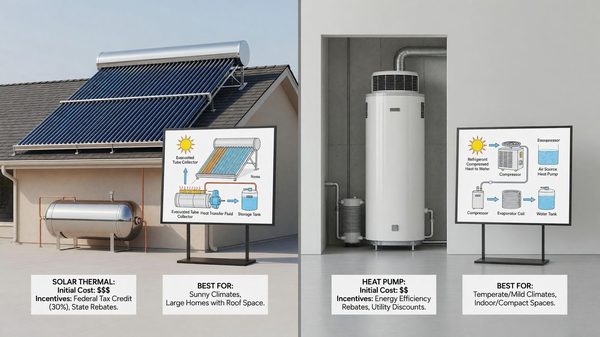
Solar water heating lost its federal subsidy on December 31, 2025. Section 25D covered 30% of installed cost with no dollar cap, and for a system quoted at $7,000 that credit was worth $2,100 — a meaningful share of the decision for most households that made it. Quotes issued in 2026 carry the full price.
The question that follows is usually framed as whether solar thermal is “still worth it.” That framing hides the more useful answer, because the credit that disappeared was not the only one. Working through what actually changed is more instructive than a yes or no.
What the Credit Was, and Exactly When It Ended
Section 25D applied to solar water heating, rooftop photovoltaics, geothermal heat pumps, small wind, and battery storage. The One Big Beautiful Bill Act terminated it for expenditures made after December 31, 2025.
The timing rule is stricter than most homeowners expect. IRS guidance ties the credit to the year the property is installed and ready for use, not the year it was ordered or paid for. There is no beginning-of-construction safe harbor on the residential side. A contract signed and deposited in November 2025 against a February 2026 install produced no credit at all. Households that had unused credit from earlier years can still carry those amounts forward; that is a different mechanism from earning new credit.
The Payback Arithmetic, Recalculated
Water heating is not a marginal load. EIA’s residential consumption data puts space heating and water heating together at nearly two-thirds of U.S. home energy use, and water heating alone is typically the second- or third-largest single end use in a home after space conditioning.
Against that load, the Department of Energy estimates a residential solar water heating system displaces roughly 50% to 80% of water-heating energy, with the upper end concentrated in high-insolation regions. That range is the honest one to build on — it is wide because collector area, tank sizing, household draw pattern, and climate all move it.
The recalculation works like this. Take your current annual water-heating cost, multiply by the displacement fraction you can defend for your climate, and divide the installed quote by the result:
Simple payback (years) = installed cost ÷ (annual water-heating cost × displacement fraction)
The credit’s removal changes only the numerator, but it changes it by 30%, which moves payback by the same proportion. A system that penciled at nine years with the credit pencils at roughly thirteen without it. One that was at fourteen is now near twenty — and twenty years is at or past the service life of the collectors’ seals, pumps, and controllers, which is where a payback calculation stops being a useful decision tool.
Two variables decide which side of that line you land on, and neither is the equipment:
What fuel you are displacing. Electric resistance water heating is expensive per delivered Btu; natural gas is not. EIA’s price comparison across fuels has consistently shown electricity costing several times more per million Btu than gas. A household on electric resistance in a sunny region has roughly the payback of a household on gas in the same region — doubled in its favor. Displacing cheap piped gas is where solar thermal payback goes long.
Whether you actually use the hot water. Solar thermal savings scale with draw volume. A four-person household with two teenagers is a fundamentally different investment from a two-person household that showers once a day. Collector capacity that sits idle earns nothing.
The Comparison That Did Not Change
Here is the part that gets misreported. The usual 2026 conclusion is that solar thermal lost its advantage to heat pump water heaters. That is not what happened, because the heat pump water heater credit ended on the same day.
Section 25C — the energy efficient home improvement credit, which covered 30% of cost up to $2,000 for qualifying ENERGY STAR heat pump water heaters — was terminated by the same legislation for property placed in service after December 31, 2025. Both technologies lost federal support simultaneously.
So the head-to-head between solar thermal and a heat pump water heater is roughly where it was in 2025, adjusted for equipment pricing. What changed is the comparison between either of them and simply replacing a failed tank with a conventional one. That is the decision that got harder, and it got harder for every efficiency upgrade at once.
This matters practically because a heat pump water heater remains the lower-capital path in most of the country — a smaller installed cost, no roof penetrations, no glycol loop, no freeze protection, and a Uniform Energy Factor above 3 in conditioned space. Solar thermal’s case is strongest where a heat pump’s case is weakest: unconditioned garages in hot climates where the heat pump steals conditioned air, very high draw volumes, and regions with abundant sun and expensive electricity.
What Is Left to Claim
The federal layer is gone, but it was never the only layer. Before pricing a 2026 system, check:
- State and utility incentives, which are unaffected by the federal change. DSIRE is the authoritative database; several states with solar thermal programs still carry rebates, and some utilities credit solar water heating for peak-demand reduction rather than energy alone.
- Income-qualified rebate programs, where point-of-sale rebates for electric and heat pump water heaters continue to run through state energy offices on their own timelines.
- Local permitting and interconnection costs, which do not change with the tax code but vary widely enough between jurisdictions to move a $6,000 project by several hundred dollars.
The Practical Read
If you are in the Southwest or Southeast, on electric resistance water heating, with a household that uses real hot-water volume, solar thermal still pays back inside the equipment’s service life without any federal credit. That case survived 2025 intact.
If you are on natural gas, in a cloudier region, or in a two-person household, the credit was doing more work than the physics was, and its removal is decisive. In that situation the better question is not solar thermal versus nothing — it is a heat pump water heater versus nothing, at a lower capital number and a shorter payback.
Get the quote priced against your actual utility bill rather than a national average, and ask the installer for the displacement fraction they are assuming and where it comes from. A number they cannot source is a number that is doing sales work rather than engineering work.